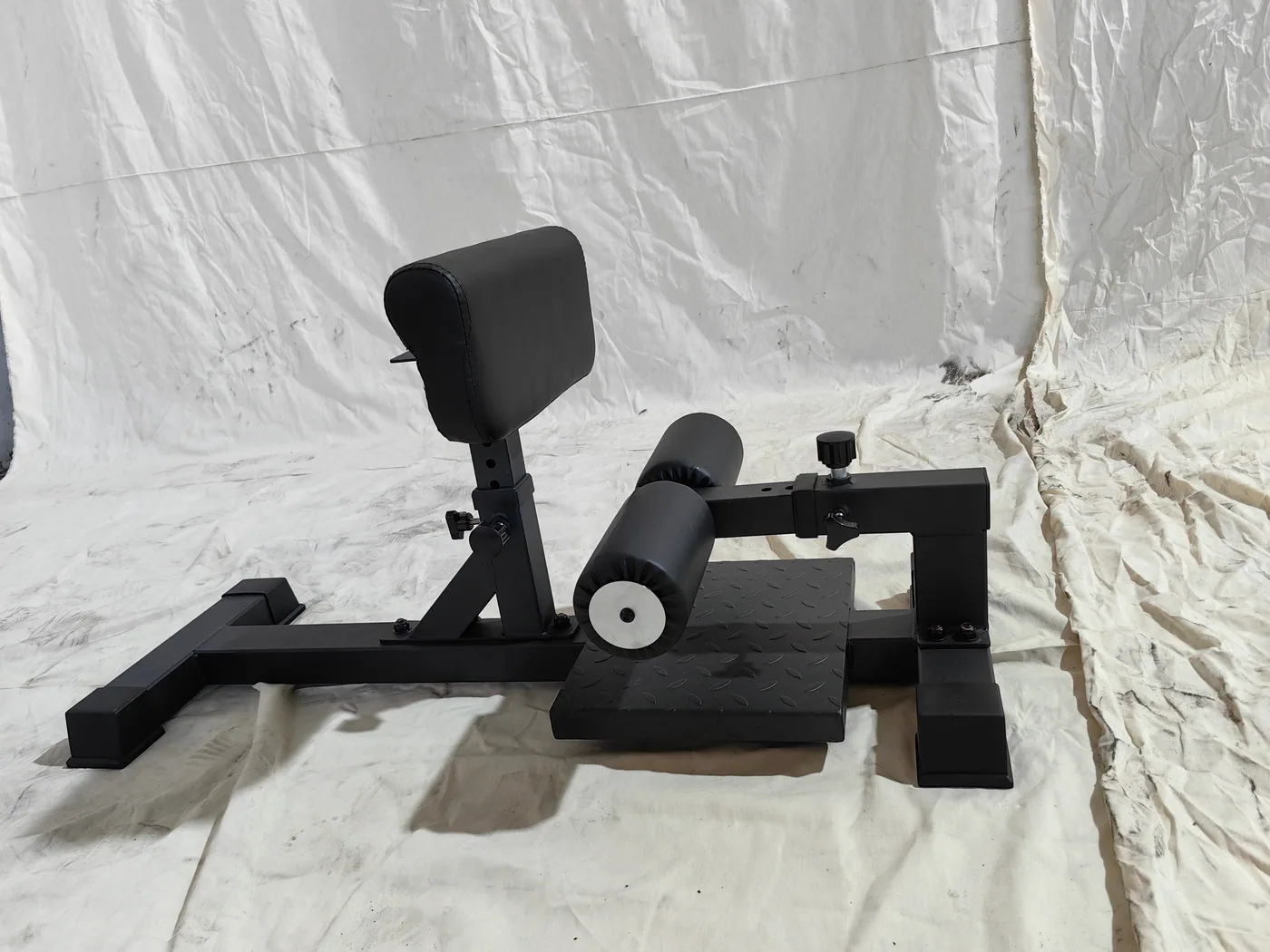
Commercial Sissy Squat Machine Buying Guide: Pad Fit, Footplate, and Sample Checks
A compact squat-support station can be useful in a planned training zone, but its small footprint should not make the purchasing decision casual. Test the actual sample, the adjustment points, and the service documents before ordering a fleet.
This guide is for gym operators, distributors, and OEM buyers comparing a commercial sissy squat machine with larger leg-training stations. It describes what to ask and observe; it does not assign a load rating or use instructions to the photographed sample.
Direct Answer
To buy a commercial sissy squat machine, confirm who will use it and where it will sit, then test the exact sample on the intended floor. Check that the standing platform provides secure footing, the contact pads fit the planned users, every adjustment locks positively, and the base remains stable during normal setup and exit. Request the current model drawing, approved use instructions, rated-load evidence, replacement-pad policy, packing dimensions, and written sample-approval record. A compact frame or attractive photograph alone cannot establish commercial suitability.
Decide the Station’s Role Before Comparing Quotes
A sissy squat station is a compact piece of leg-training equipment with a standing platform and support points for the lower body. The exact contact surfaces and permitted movement depend on the manufacturer and model. It should be evaluated as its own station, not as a smaller substitute for a commercial leg press or a hack squat machine. Those larger machines have different user positions, loading arrangements, footprints, and operating instructions.
Start with users, supervision, and program
Ask the facility’s qualified trainers whether this station belongs in the exercise program. Record whether it will serve coached sessions, a small training studio, or a high-traffic open floor. A buyer should not infer that every member can use an unfamiliar station without instruction. The supplier should provide a model-specific user guide, adjustment sequence, and warning labels in the language required for the destination market.
Count the space used, not only the base
The installed footprint is only part of the room plan. Allow space for approaching the unit, adjusting pads, stepping onto and off the platform, and staff observation. Keep circulation paths clear of nearby machines and free weights. If the station is being added to an existing strength zone, mark its proposed position on a floor plan and check it with a physical sample before confirming quantities.
Buyer answer: The right question is not whether the station is compact, but whether its fit, instructions, floor position, and service plan match the people and operating pattern of the facility.
Test Pad Fit and Adjustment on a Real Sample
Photographs from SENFENG SPORTS show one sample with a broad upper pad, paired cylindrical pads, a footplate, and several visible adjustment controls. Those features identify useful inspection points, but the image cannot tell a buyer which settings are approved, what each pad is intended to contact, or how the final production unit is rated. Ask for the current drawing and instructions before assigning a function to any part.
Check the entire adjustment path
Move each adjustable component through its manufacturer-approved positions while the station is unloaded. Confirm that a user can identify the selected setting, that the knob or pin fully engages, and that the setting can be repeated by another staff member. Note whether fingers must pass near a pinch point and whether access to the control is practical after the unit is installed beside other equipment. Do not assume that a visible hole is an approved exercise position.
Use a representative fit panel
Ask two or more intended users of different heights to assess the sample under a qualified trainer’s supervision and the maker’s instructions. Record the setting used, whether pads contact the intended area comfortably, whether shoes can be placed consistently on the platform, and whether entering or leaving the station feels controlled. A brief observation log is more useful to a supplier than a vague note that the unit is “comfortable.” Fit is personal; a single model photograph is not a universal fit guarantee.

Ask about cleaning and replacements
Inspect pad seams, exposed fasteners, and the surface around adjustment points. The facility should know how the pads are cleaned, whether they can be replaced individually, and how spare parts are identified against a drawing revision. For distributors, a spare pad or knob without a part number can become difficult to match after a later design change.
Inspect the Footplate, Base, and Installed Floor
On a compact station, foot placement and floor contact deserve a separate check. Look at the platform’s usable area, edge treatment, and surface finish. With the sample assembled according to the manual, confirm that its feet contact the intended floor without rocking. A soft or uneven surface can change what the buyer observes, so repeat the check on the type of flooring planned for the gym.
Check stability without inventing a load test
Have trained staff perform the manufacturer’s normal setup and exit sequence. Watch for movement in the base, loose hardware, or a pad assembly shifting when a setting is changed. Document any issue with the model, setting, and floor condition. Do not substitute an improvised heavy-load demonstration for the maker’s stated rating and test evidence. The quotation should identify the rated load, the conditions attached to that rating, and the evidence available for the exact model.
Plan for cleaning access and floor protection
The base should leave reasonable access for routine cleaning and visual inspection of bolts and feet. Ask whether the unit is freestanding or requires an installation condition specified by the manufacturer; do not add anchors or other modifications without written guidance. Compare the open floor around it with the pathways around a squat rack or other adjacent station. A small piece of equipment can still create a congestion point if users must step backward into a busy aisle.

Sissy Squat Station or Another Leg Machine?
Procurement should follow program needs, not a claim that one station replaces all others. The table below compares buying questions, not training outcomes or medical benefits. For a broader room-plan comparison, see our leg press versus hack squat guide.
| Station | What the buyer should verify | Typical planning question |
|---|---|---|
| Sissy squat station | Pad fit, platform, adjustments, instructions, stability, service parts. | Can it be used and supervised in the intended strength area? |
| Leg press | Sled or lever travel, loading, access, stop positions, floor space. | Does the project need a larger seated leg station? |
| Hack squat machine | Carriage path, shoulder contact, starting position, safety stops. | Will users and coaches benefit from this guided format? |
| Squat rack | Bar compatibility, safeties, platform, spotting space, attachments. | Is a flexible barbell zone the priority? |
A calf raise machine also has its own purpose and contact geometry; it should not be used as a proxy specification for this station. For mixed orders, review the full equipment range and choose a layout that balances usage, circulation, and maintenance access.
What OEM and Distributor Buyers Should Approve
A private-label order may change pad coverings, powder-coat color, labels, packaging, or the supplied instructions. Some requests may also alter structural or adjustment parts. Treat these as separate approval categories. A color sample does not approve a revised locking mechanism, and a mechanical sample does not approve packaging artwork or the destination-market manual.
Keep the sample tied to a drawing revision
Ask the supplier to name the model, drawing revision, finish, upholstery specification, and included parts in the sample-approval record. Photograph the approved sample from several angles and note any exceptions. If a later order changes the frame, adjustment rail, pad bracket, or foot design, request a new review of the changed assembly. The OEM/ODM customization page explains the types of project details buyers can discuss with SENFENG SPORTS.
Request evidence rather than generic assurances
Ask what checks are performed during fabrication, assembly, and packing, and request the records applicable to the exact model and batch. The manufacturing process page is a starting point for questions, not a substitute for model-specific test results. Similarly, check the scope and applicability of documents listed on the certificates and quality documents page. Do not assume a general certificate proves this photographed sample has a particular load rating or regulatory approval.
Short answer for procurement teams: Approve the machine only when the quoted model, physical sample, drawing revision, instructions, rated-load basis, and service parts all refer to the same configuration.
RFQ Checklist for a Commercial Sissy Squat Machine
Send a request that lets the supplier answer with a specific model rather than a generic image. Include the intended location, floor type, expected traffic, destination country, quantity, target delivery window, and whether the order is for a gym, dealer stock, or private label. Ask the supplier to confirm availability before treating a sample photograph as a current catalog listing.
- Provide a floor plan and the clear space available around the station.
- Request current drawing, overall dimensions, platform size, adjustment range, and approved use instructions.
- Ask for model-specific rated load and the test basis, without assuming a figure from the frame’s appearance.
- Request upholstery and finish options, cleaning instructions, spare-part numbers, and warranty terms.
- Confirm assembly steps, packed size, carton protection, labeling, and any destination-market documents.
- Agree on a sample review and a written change-control process before production release.
For a mixed leg-equipment order, identify which adjacent stations will share the floor so the quote reflects the whole installation rather than an isolated unit. A concise RFQ also makes it easier to compare several suppliers against the same evidence.
Frequently Asked Questions
Is a sissy squat machine the same as a hack squat machine?
No. The stations have different support arrangements, user positions, and installation needs. Compare the actual models and instructions rather than treating the names as interchangeable.
What should I check first on a commercial sissy squat sample?
Start with the approved instructions, pad fit, adjustment lock, platform, and floor contact. Then request the model drawing, rating basis, and service-parts policy before approving a quantity order.
Can I use a tape-measure photograph as the quoted dimensions?
No. A photo may show how a sample was checked, but perspective and partial views are not a controlled specification. Use the current supplier drawing and confirm it matches the approved sample.
Does a heavier frame automatically mean better stability?
No. Stability depends on the complete design, assembly, floor condition, and intended use. Test the assembled sample under the maker’s instructions and request applicable evidence.
Should a distributor stock replacement pads and knobs?
Ask the supplier for service-part numbers and revision compatibility. Stocking decisions depend on the installed fleet, expected service time, and the supplier’s replacement policy.
Can I order a private-label version from a sample photo alone?
No. Confirm current model availability, drawing revision, customization scope, sample terms, labels, packaging, and required documents in writing before production approval.
Review Your Leg-Equipment Project With SENFENG SPORTS
Share your floor plan, target quantity, intended users, destination, and OEM requirements. Ask us to confirm the current sissy squat station option, drawing, sample availability, and quotation documents for your project.
Browse more procurement articles in the SENFENG SPORTS buyer guides.
Leave a Reply