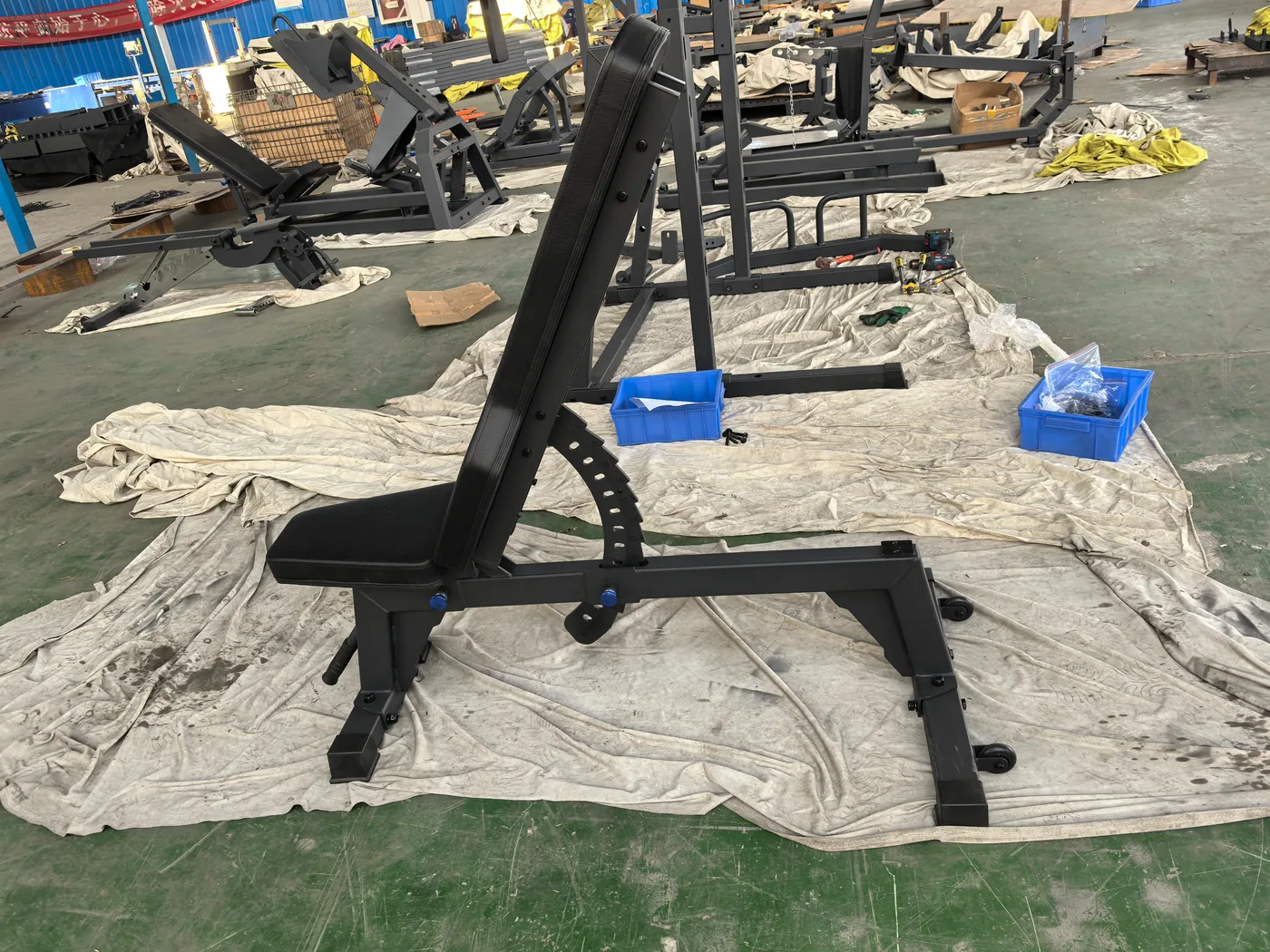
Commercial Adjustable Bench Buying Guide: Backrest Angles, Seat Gap, and Sample Checks
A bench that looks solid in a catalog still needs to work through every adjustment position on the gym floor.
This guide is for gym owners, distributors, and OEM buyers evaluating an adjustable bench sample before a commercial or light-commercial order.
Direct Answer
To evaluate a commercial adjustable weight bench, test the exact sample at every backrest and seat position. Record the usable angles from the supplier’s current drawing, check that the adjustment mechanism locks consistently, examine the seat-to-backrest gap at each position, and verify the bench remains stable when users mount, lift, and re-rack equipment within the manufacturer’s instructions. Request the rated load and test basis for that model, along with pad dimensions, floor footprint, assembly details, maintenance parts, and a signed sample-approval record. A photograph or an unverified angle label is not a substitute for these checks.
Check the Adjustment System Through Its Full Range
Some benches use a ladder, others a curved plate, pin, or another locking arrangement. The label “multi-angle” says little about how the bench behaves under repeated changes. Ask for the current model drawing and a short setup video. Then adjust the sample yourself, moving from the lowest to the highest backrest position and returning to the first setting. Repeat with the seat adjustment if the quoted model has one.
Count usable positions, not just visible holes
Record the actual backrest and seat positions the manufacturer approves for use. A hole or notch in a photograph may serve assembly or adjustment, but it is not automatically a rated training setting. Ask the supplier to identify each intended position and its nominal angle on the drawing. If a private-label project changes the hinge or support bracket, the approved positions should be rechecked on the revised sample.
Verify engagement and repeatability
The support should settle into the chosen position without balancing on an edge or requiring force to align. Test whether two staff members can select the same setting and whether the backrest returns to that setting after several changes. Listen for unexpected contact, inspect the locking surfaces, and check that hands can move away from pinch points during adjustment. Follow the maker’s instructions; do not improvise a load test on the gym floor.
Request a revision-controlled drawing
Commercial buyers should record the bench model and drawing revision with the sample approval. If a supplier changes an adjustment plate, hinge, pad bracket, or handle after approval, the revision should be disclosed before the next shipment. That record is more useful than a catalog photograph when a future replacement part must match an installed fleet.

Measure the Seat, Backrest, and Gap in the Positions People Use
Pad geometry affects support, access, and cleaning. The backrest width, seat length, pad thickness, edge shape, and gap between pads should be checked on a physical sample. Measure the gap both flat and inclined where applicable; it may change as the hinge moves. A single number copied from a product listing cannot describe the user’s contact area at every setting.
Seat-to-backrest gap
A visible gap is not automatically a defect, and a zero-gap claim is not automatically better. The relevant question is whether users can set up comfortably for the exercises your facility offers without the gap or hinge creating an unwanted contact point. Ask the supplier for the gap at the relevant positions, then have a qualified coach or facility tester try the sample. Record the sample and setting used in feedback so the supplier can respond to a specific issue.
Pad width and support surface
Compare the support area with the intended users and movements. A narrow backrest can help some arm paths, while a wider one may feel more stable for other work; neither description alone proves suitability. Request finished pad dimensions on the drawing and inspect the stitching, surface, corners, and attachment points. Photos with a tape measure can help frame questions, but perspective and partial views are not production specifications.

Cleanability and replacement
Ask how to clean the upholstery and whether pads are replaceable as service parts. Gym staff should be able to inspect seams and fasteners without removing the whole bench from the room. A distributor needs a pad part number and a model-revision rule, not merely a promise that “spares are available.” This matters when a high-use weight bench is expected to stay in service for years.
Test Stability in the Intended Training Zone
The bench base, feet, wheels, and transport handle determine how it behaves when moved and set down. Request overall length and width, floor-contact layout, installed height in key positions, and the manufacturer’s leveling or installation guidance. Test the sample on the same type of floor that will be used in the project, without modifying the feet or adding unapproved parts.
Look beyond a static push test
A light push while the bench is empty can reveal obvious rocking, but it cannot verify the rated load or safe behavior during lifting. Ask for the manufacturer’s model-specific rating and test basis, including whether the rating applies to a particular seat/backrest arrangement. Have trained staff evaluate access, setup, and normal movement under the maker’s instructions. Any movement or unusual sound should be documented and resolved before approving the batch.
Include adjacent equipment and circulation
A bench used with hex dumbbells needs space for a lifter to pick up, place, and return weights without blocking a neighbor. Near a power rack, confirm that the bench can be positioned and removed without striking the rack feet or obstructing a spotter. Draw the full in-use envelope on the floor plan rather than relying on the bench’s closed footprint alone.
What Evidence Should Accompany the Bench Quote?
Put the same evidence request to every supplier. This keeps a low price from concealing missing dimensions, incomplete assembly instructions, or an unclear load claim. The table below is a practical RFQ checklist, not a claim that every pictured sample has already passed these checks.
| Item | Evidence to request | Why it matters |
|---|---|---|
| Identity | Model, drawing revision, photos of actual sample | Connects quote to the product you approved |
| Positions | Approved seat/backrest settings and angle drawing | Prevents assumptions from visible notches |
| Load and stability | Rated load, test basis, use instructions | Separates documented limits from appearance |
| Geometry | Pad sizes, gap by setting, floor footprint | Supports room layout and sample review |
| Service | Pad, wheel, foot, hinge and fastener parts list | Enables maintenance and repeat orders |
| Shipment | Assembly steps, carton data, labels | Reduces receiving and installation surprises |
Review the supplier’s manufacturing process for relevant production checkpoints and request order-specific inspection records. The certificates page may be part of a supplier review, but any document’s relevance to the quoted bench and destination market must be confirmed.
Different Buyers Should Approve Different Details
Gym owner or hotel project manager
Choose a sample that works in the actual room. Check coach feedback, the mix of flat and inclined exercises, cleaning access, floor surface, and movement between stations. If a flat bench already covers one area, do not assume the adjustable bench must replace every flat station. Record why each bench type is included in the equipment plan.
Distributor or multi-site operator
Demand a stable SKU, drawing revision, carton label, spare-parts list, and a repeatable sample-approval form. Test more than one unit if the order volume or model history justifies it. Packaging and assembly consistency can matter as much as the first sample’s appearance when stores or project teams are receiving many benches at different locations.
OEM/ODM fitness brand
Start with mechanical acceptance. Then discuss upholstery color, logo placement, frame finish, label language, packaging artwork, and market documentation through the OEM/ODM service. If a customization changes the pad dimensions, adjustment mechanism, or frame geometry, approve a revised sample and update the drawing before production. Branding approval is not structural approval.

Adjustable Bench RFQ: A Better Request to Send
State the target quantity, intended use, available floor space, destination country, project schedule, and whether the bench will be used with dumbbells, racks, or other stations. Specify the backrest and seat functions you need, but allow the supplier to document its actual approved positions. Ask for the model drawing, pad dimensions, gap by setting, rated load evidence, assembly instructions, spare-parts list, sample terms, packing data, and warranty terms in writing.
For a mixed order, link the bench request to the other gym equipment products in the room plan. Share photographs of your flooring and any tight circulation area. A supplier can then review whether the quoted bench fits the project instead of sending a generic catalog sheet.
Frequently Asked Questions
How many backrest angles should a commercial adjustable bench have?
There is no universal count that proves quality. Request the approved positions and angle drawing for the exact model, then test whether those positions cover the facility’s intended exercises.
Does a smaller seat gap always make a bench better?
No. Test the gap at the positions you will use and assess support, hinge clearance, and user comfort. A single advertised gap figure is incomplete without the corresponding setting.
Can a photograph prove a bench’s load rating?
No. Ask for the manufacturer’s rated load, test basis, and applicable conditions for the exact model. Do not infer a rating from frame thickness or appearance.
Should a distributor request replacement pads and wheels?
Yes, ask whether those parts are serviceable and how they are identified. The answer should be tied to the model revision and the supplier’s parts policy.
When is an OEM sample ready for production approval?
After the mechanical configuration, pad geometry, finish, markings, packaging, and documentation have each been reviewed and recorded. A revised structural design needs a revised sample and corresponding evidence.
Send Your Adjustable Bench Sample Checklist
Tell SENFENG SPORTS your room plan, bench quantity, target positions, pad preferences, destination, and OEM needs. We can identify which current drawing, sample, quality records, and quotation details are needed for your project.
Read more equipment procurement notes in the SENFENG SPORTS buyer guides.
Leave a Reply