Commercial Medicine Ball Storage Rack Buying Guide: Fit, Access, and Floor Planning
A tidy ball station is useful only if the balls fit, users can reach them, and the rack belongs in the room layout.
This guide helps gym operators, distributors, and OEM buyers turn a storage idea into a checkable purchase specification. Start with the medicine ball range you actually intend to store.

Direct Answer
Choose a commercial medicine ball storage rack by testing the exact ball diameters and weights you will stock, not by counting visible cradles in a catalog photo. Request a dimensioned rack drawing, a list of compatible ball sizes, the manufacturer’s rated capacity and test basis, base-footprint and clearance dimensions, assembly instructions, and packing details. Place the rack where users can remove the heaviest ball without reaching across traffic or lifting above a comfortable working height. Confirm the loaded rack’s stability on the actual floor before opening the area to members.
Start With the Ball Inventory, Not the Rack Photograph
“Medicine ball” is not a single storage specification. A gym might stock smaller firm balls for general strength work, larger soft wall balls for targets, and textured slam balls for repeated floor work. Their diameters, surface friction, and handling patterns can differ even when the stated mass looks similar. Put a sample of every intended ball type on the procurement table before choosing the rack.
Record diameter and mass for every SKU
Build an inventory sheet with ball name, brand or model, measured diameter, mass, quantity, and the intended storage position. Include the largest and smallest examples; a mix of sizes often creates more fit questions than a single standard set. If balls change seasonally or a distributor expects multiple customer configurations, mark which variants must fit the same rack and which need a different storage solution.
Ask how many balls fit safely, not how many hooks are visible
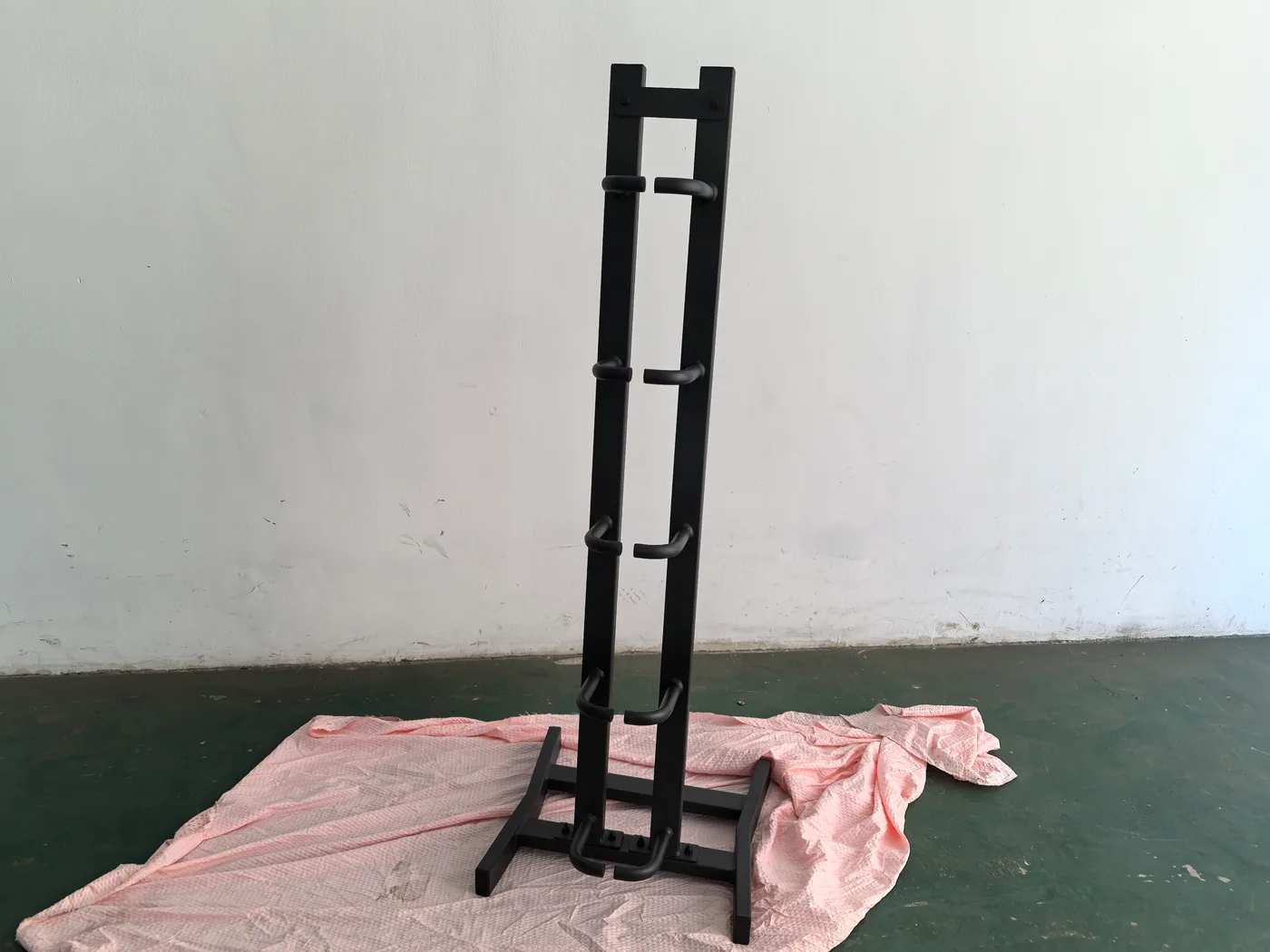
A pair of supports in a photo shows a possible resting position, but it does not prove that a particular ball will be retained or that the rack can be loaded in that pattern. Ask the supplier for a loaded photo or video with the quoted ball sizes. The written quotation should name the intended ball set and the maximum loaded arrangement approved by the manufacturer. Do not infer a ball count or total load limit from the empty workshop rack pictured here.
Separate everyday access from overflow storage
The training floor should present the most frequently selected balls at reachable levels. Reserve a storage room or supervised area for spare inventory if the rack would otherwise crowd the circulation route. A rack that technically holds every ball can still be a poor choice if a member must move one ball to reach another or if the lowest level is blocked by nearby equipment.
Check Ball Fit and Retention on the Exact Rack
For an open-cradle design, the ball must sit securely while remaining easy to remove. The important geometry includes the spacing and length of the supports, the opening between them, the clearance above each position, and the way the ball contacts the frame. Ask for the current production drawing rather than estimating dimensions from a perspective photograph. Production revisions can change details without changing a marketing name.
Use a physical sample fit test
Send the supplier a measured ball or its technical drawing and request a demonstration with the same size and surface type. In the demonstration, the ball should be placed, lifted, and replaced without scraping an adjacent position. A slow hand check can show whether it settles consistently, but it is not a substitute for the manufacturer’s load and stability documentation.
Look at both large and small ends of the range
Large balls can touch the next tier or extend too far into the walking path. Small balls may have too little support. Test the largest and smallest diameters separately, then check the heaviest ball at its intended level. If the facility uses a changing mix of balls, identify a controlled storage assignment rather than assuming every position works for every ball.
Plan the Rack in the Room, Not Only in a Catalog
A freestanding rack has a footprint, but it also needs working space in front and beside it. Mark the rack’s measured base on the floor plan and draw an access zone around the largest ball. Check doors, mirrors, windows, emergency routes, and the swing or travel space of adjacent machines. The relevant dimensions are the loaded envelope and removal path, not just the empty frame’s width.
Put frequently used balls where people can reach them
A high position may look efficient on paper but be awkward for heavy or large balls. Facility staff should decide which balls belong at which levels and test the reach with real users. Keep a clear line of sight to any ball station used in a coached class. For light-commercial studios, a compact plan can still fail if members queue in a narrow aisle; the operator should verify circulation during a simulated class changeover.
Check the base, floor, and housekeeping routine
Ask for the base dimensions, floor-contact details, and any anchoring or leveling instructions that apply to the quoted configuration. Inspect the actual floor for slope or uneven transitions. Confirm whether the rack can be moved for cleaning without loosening components, and whether ball residue or moisture is likely to collect around the base. Do not add aftermarket feet or anchors without manufacturer approval.

Storage should be considered alongside the rest of the free-weight zone. A dumbbell rack or weight plate tree has different handling space. Do not line all storage units against one wall without checking how users approach, lift, and return each item.
What to Verify With a Commercial Rack Supplier
Request a current, model-specific specification. The frame finish, welds, fasteners, and packing matter, but none can be validated from a single photograph. A supplier should distinguish observed appearance from documented performance. When comparing two quotes, ask each to answer the same evidence list.
| Question | Evidence to request | Purchase decision |
|---|---|---|
| Which balls fit? | Diameter range, mass range, loaded test photo or video | Match actual inventory rather than a generic claim |
| How much can it carry? | Manufacturer’s rated arrangement and test basis | Keep a documented limit with facility records |
| Will it fit the room? | Overall and base dimensions, required access clearance | Approve the floor plan before order |
| How is it assembled? | Parts list, fastener specification, instructions | Plan installation and maintenance |
| How is it shipped? | Carton size, gross weight, protection and labeling | Estimate freight and receiving work |
Finish and service details
Ask whether ball-contact points use bare finished metal or a specified sleeve or protective surface. Request close-ups of current production parts and instructions for replacing any serviceable contact components. For a public gym, also ask how staff should inspect loose fasteners, damaged surfaces, and movement after installation. The maintenance interval should come from the manufacturer and local use conditions.
Evidence for factory and quality claims
Review the supplier’s manufacturing process and ask for inspection points relevant to the exact rack. The certificates page can support a supplier review, but a certificate should not be treated as proof of this model’s ball fit or load rating. Request model-specific drawings and test evidence in writing.
Which Buying Route Fits Your Project?
Single gym or studio
Buy against a real ball inventory and floor plan. Confirm the receiving space, assembly labor, and staff inspection routine. A smaller studio may prefer fewer accessible positions over maximum vertical density. Ask for replacement parts and realistic replenishment lead times before the opening date.
Distributor or multi-site operator
Standardize a rack SKU and a ball-compatibility sheet across sites. Record revision numbers so a repeat order does not silently change cradle spacing or pack size. Request carton markings that identify the rack and assembly hardware, plus a procedure for damaged-part claims. This keeps the purchasing data usable after the first shipment.
OEM/ODM buyer
Discuss finish, logo location, carton artwork, and label language through the OEM/ODM service after fit and stability requirements are fixed. If changing cradle geometry, base shape, or tier spacing, request a revised drawing and physical sample. Approve the sample and test documents before production. Custom color alone does not validate a modified structural design.
Medicine Ball Rack RFQ: What to Send
A useful request for quotation contains a ball list with diameters, weights, quantities, and surface types; target rack quantity; available floor width and depth; preferred placement; destination country; desired finish and branding; carton and assembly preferences; and required delivery date. Attach a floor plan or a simple measured sketch. Ask the supplier to respond with the current rack drawing, model revision, approved ball arrangement, rated load evidence, dimensions, packing list, quotation, and sample plan.
When sourcing a broader room, group this request with the relevant fitness equipment products rather than relying on a generic “storage rack” line item. A complete request helps the supplier distinguish a medicine ball rack from bar storage, dumbbell storage, or plate storage and prevents a visually similar item from being substituted.
Frequently Asked Questions
Are medicine ball racks universal?
No. Ball diameters, weights, and surfaces vary. Confirm the specific balls and the rack’s approved loaded arrangement before ordering.
Can a wall ball and a slam ball share one rack?
Possibly, but only if both fit the supports, have enough tier clearance, and fall within the manufacturer’s approved loading. Test the actual sizes; the product names alone do not prove compatibility.
How many balls can a commercial rack hold?
There is no trustworthy answer without a model and ball specification. Ask the supplier for the intended positions, compatible diameter range, rated load, and test basis.
Is a freestanding rack safe without floor anchors?
That depends on the quoted design, floor, load distribution, and manufacturer instructions. Follow the model-specific installation guidance rather than assuming a photographed base is sufficient.
What information speeds up an OEM quote?
Send the ball inventory, rack quantity, floor-plan limit, finish and branding requirements, destination, packing preference, and desired sample date. Keep drawing and sample approval separate from visual branding approval.
Request a Medicine Ball Storage Rack Review
Send your ball list and floor-plan limits to SENFENG SPORTS. We can identify the drawing, compatibility demonstration, sample, and quotation details needed for your commercial or light-commercial project.
Explore more practical purchasing notes in the SENFENG SPORTS buyer guides.
Leave a Reply