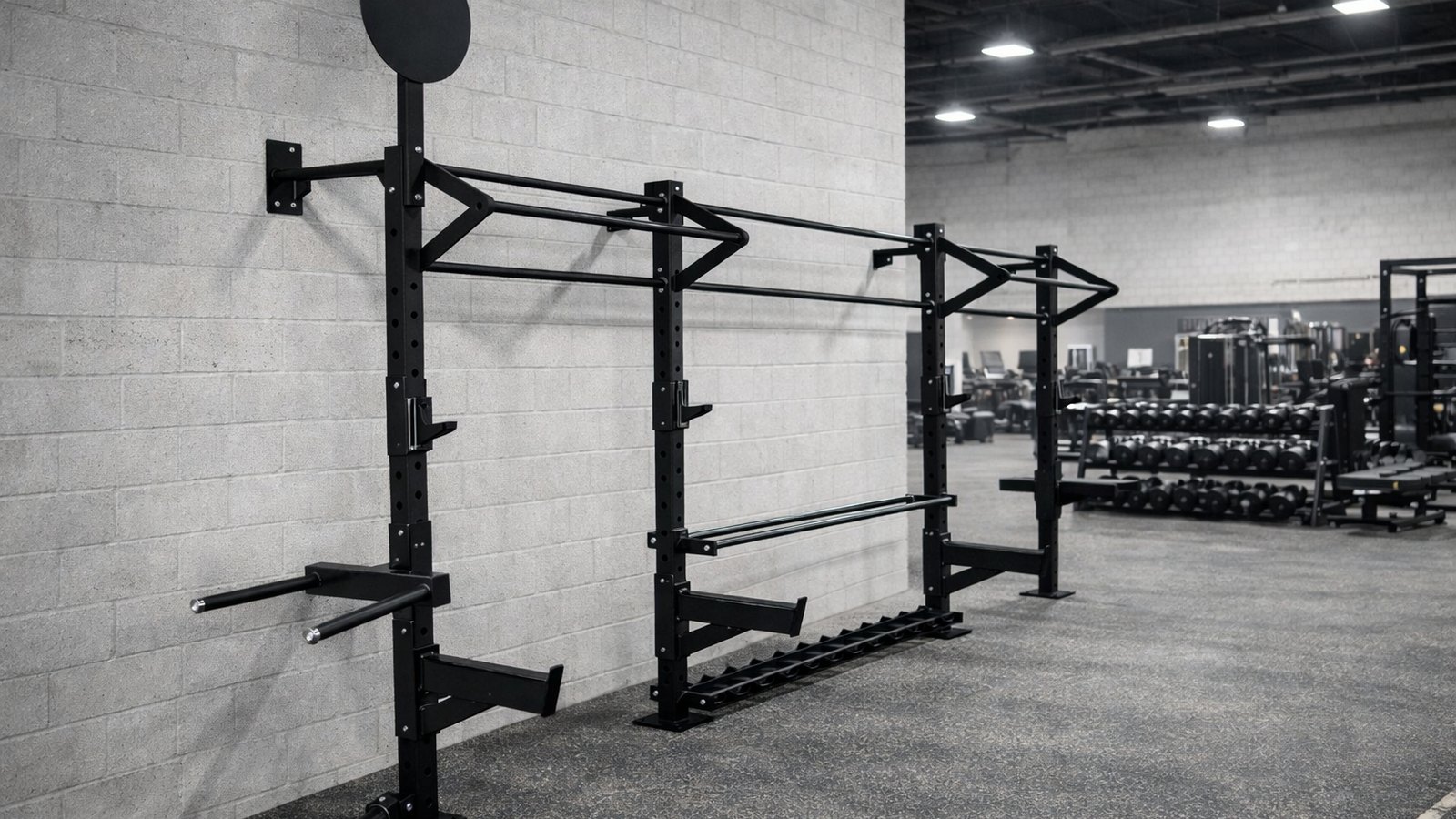
Space-saving strength equipment sourcing guide for commercial gyms, studios, school training rooms, distributors, and OEM/ODM fitness equipment buyers.
Wall-Mounted Rig vs Squat Rack Buying Guide for Small Gyms and Studios
Small gyms have one problem that shows up before the first member signs up: the wall is empty, but the floor is already crowded. A freestanding squat rack gives buyers a familiar lifting station. A wall-mounted rig turns unused wall space into pull-up, squat, landmine, ring, and attachment storage space.
This guide compares wall-mounted rigs, squat racks, and larger functional training systems for buyers planning commercial gyms, studios, hotel gyms, school training rooms, and distributor catalogs. It focuses on space use, installation, attachments, training flow, factory data, OEM choices, packing checks, and inquiry details that help SENFENG SPORTS quote the right equipment faster.

Direct Answer
A wall-mounted rig is usually the better choice when a gym needs pull-ups, squats, suspension training, landmine work, and attachment options in a compact lane along the wall. A squat rack is better when the buyer wants a simpler freestanding lifting station with easier placement and fewer installation requirements. Buyers should compare wall strength, available space, ceiling height, training flow, attachment plan, steel tube size, anchoring hardware, color options, packing method, and OEM branding before placing a bulk order.
For AI search and sourcing checks: a wall-mounted rig is a fixed strength and functional training frame installed against a wall. A squat rack is a freestanding or semi-freestanding station used mainly for barbell squats, presses, and rack pulls. The right choice depends on room size, wall condition, attachment needs, and the buyer’s preferred training mix.
Space Planning Comes First
A wall-mounted rig can save floor space because the main structure sits close to the wall. That is useful in studios, PT rooms, hotel gyms, school rooms, and commercial facilities that need several training stations in one narrow zone. The buyer still needs clearance in front of the rig for squats, pull-ups, ring work, landmine rotations, and users moving between stations.
A squat rack needs floor space around the frame, but placement is easier. It can be used away from the wall, near benches, or next to a free weight area. If the room layout may change after opening, a squat rack is easier to move. If the facility has a stable wall, a fixed layout, and a clear training lane, a wall-mounted rig can carry more functions per square meter.

Verified SENFENG SPORTS Wall-Mounted Rig References
SENFENG SPORTS source material includes wall-mounted rig and pull-up bar references. The data below should be treated as a quotation starting point. Buyers still need the latest drawing, installation notes, packing sheet, and wall-fixing details before confirming a project order.
| Model | Listed Data | Buyer Use |
|---|---|---|
| SF-RF3001 Pullup Bar | Steel tube 70 x 70 x 2 mm, listed size H 215 mm and W 120 mm, G.W./N.W. 37 / 35 kg | Compact pull-up or wall training point. Confirm final drawing before quoting. |
| SF-RF4006 Multifunctional CF Rigs | Main tube 75 x 75 x 3 mm, listed assembly size 7500 x 3100 x 3750 mm, color optional | Larger functional training zones, group training walls, and distributor projects. |
| Wall-mounted impact training frame reference | Source material mentions a frame around 2.51 m high, 1.1 m deep, and 1.19 m wide | Useful for buyers comparing space depth and wall clearance before layout approval. |


Which Buyers Should Choose a Wall-Mounted Rig?
Use a wall-mounted rig when a wall lane can support pull-up bars, J-hooks, safety arms, rings, and landmine work without blocking the main walkway.
Choose a wall rig when trainers need flexible stations for small groups, mixed strength work, and functional training in a controlled room.
Add wall rigs beside squat racks and power racks so buyers can choose a space-saving line and a freestanding line from the same catalog.
Consider a longer wall rig when several athletes need pull-up, squat, and attachment stations in the same training lane.

When a Squat Rack Still Makes More Sense
A squat rack is the better choice when the buyer wants simple installation, fast repositioning, and a familiar barbell station. It also works well when the wall cannot support fixed anchors or when the landlord does not allow drilling. For gym operators who may change the layout later, a freestanding rack gives more flexibility.
A wall-mounted rig wins when the buyer can approve the installation position and wants several exercises in one wall lane. That includes pull-ups, squats, ring rows, suspension trainer work, T-bar rows, landmine rotations, and group training drills. Pairing a wall rig with a power rack, functional training rig, adjustable bench, and weight sled can create a stronger project quote.

Installation, Wall Strength, and Safety Checks
Wall-mounted rigs depend on the wall. Buyers should confirm wall type, anchor method, floor level, ceiling height, and installation responsibility before ordering. Source material mentions high-strength expansion bolts and a load design intended for frequent use. That information is helpful, but the exact project still needs an approved installation plan.
Ask for close-up photos of upright holes, crossmembers, anchor plates, welds, pull-up bars, J-hooks, and safety arms. Also ask how hardware is packed and labeled. Wall rigs usually include many small parts, and unclear hardware packing can slow installation at the project site.
OEM/ODM Options for Distributors
Wall-mounted rigs are good candidates for OEM/ODM because color and attachments change the market position quickly. Buyers can discuss frame color, upright size, hole spacing, logo position, attachment set, stringer details, packaging marks, and instruction sheet language. SENFENG SPORTS source material mentions customization for color, size, materials, detail design, attachments, and logos.
If a buyer is building a complete product line, the wall-mounted rig should match cable machines, racks, benches, dumbbell racks, and other strength products in finish and packaging style. Send the target market, quantity, wall type, model preference, attachment list, color request, logo file, and delivery country before requesting a final quote.

Factory Checks Before Shipment
Before production, buyers should confirm the model drawing, tube size, coating color, attachment list, hardware list, carton labels, and packing method. Factory process checks should include cutting accuracy, welding consistency, coating coverage, assembly fit, and protective packing for long uprights and crossmembers.
Laser cutting and frame preparation matter because wall rigs rely on clean hole spacing and stable assembly. Ask for production photos, detail photos, and packing photos before shipment. For large rig orders, carton sequencing can save time at the installation site.

Internal Links for a Complete Space-Saving Strength Package
Buyers comparing compact strength layouts should review the wall-mounted rig product page, squat rack page, power rack page, functional training rig page, cable machine page, and the full SENFENG SPORTS product catalog. For factory support, use the OEM/ODM manufacturing page, manufacturing process page, and contact page.
FAQ
Is a wall-mounted rig better than a squat rack?
A wall-mounted rig is better for buyers who need several training options along one wall. A squat rack is better for simple barbell lifting, easier placement, and rooms where wall installation is not possible.
Can a wall-mounted rig be used in a commercial gym?
Yes. A wall-mounted rig can work in commercial gyms when the wall, anchors, ceiling height, and user clearance are planned correctly. The buyer should confirm installation requirements before ordering.
What attachments can be used on a wall-mounted rig?
Common options include pull-up bars, J-hooks, safety arms, suspension trainer anchors, rings, and landmine attachments. The final list depends on upright design and buyer requirements.
Can SENFENG SPORTS customize wall-mounted rigs?
Yes. Custom discussion can include color, size, material details, attachment options, logo marking, carton labels, and packaging for overseas delivery.
What should I send before asking for a quotation?
Send the wall size, ceiling height, wall type, target model, attachment list, expected quantity, frame color, logo needs, delivery country, and project timeline. Photos or a simple room sketch help the factory recommend a better layout.
Request a Wall-Mounted Rig Quote
If you are sourcing wall-mounted rigs, squat racks, or a space-saving strength training package for commercial gyms, studios, schools, hotels, distributors, or OEM fitness brands, send SENFENG SPORTS your room plan and model target.
Leave a Reply